
AEO Score Bands Explained: What's Good, What's Bad, What's Average
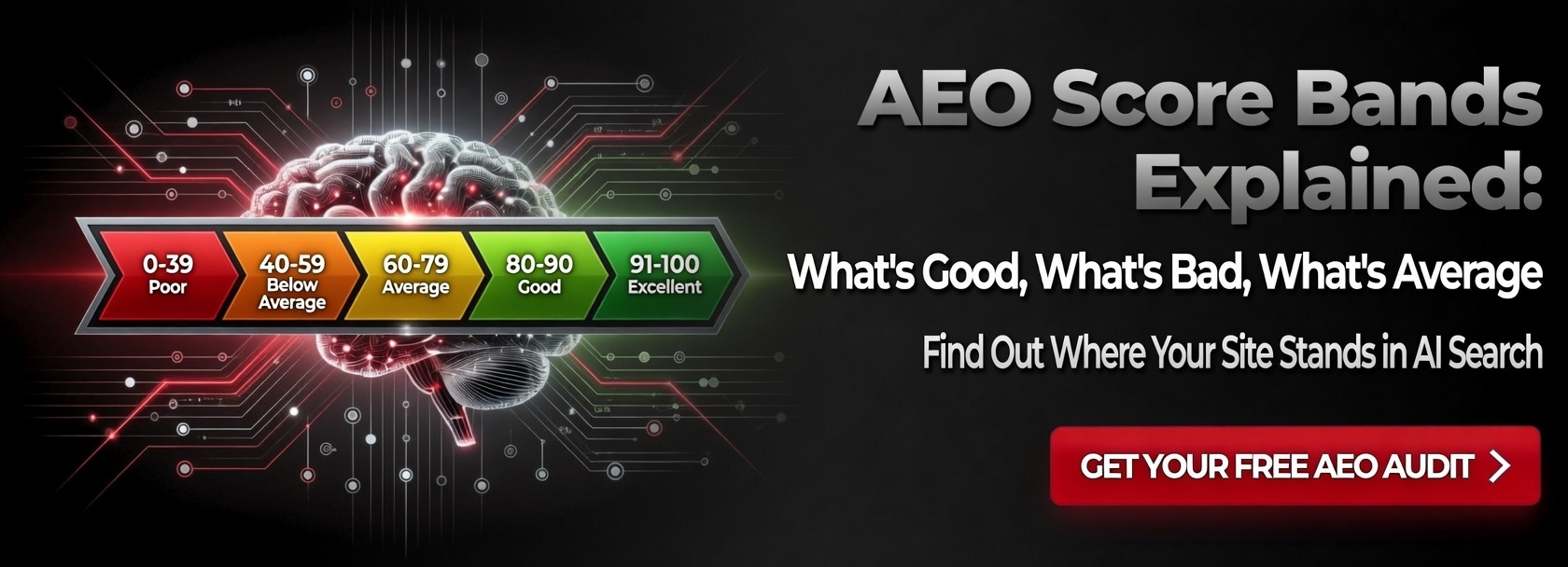
You ran an AEO audit. You got a number between 0 and 100. Without context, the number is just a number. AEO score bands give you that context.
Quick answer: Five bands: 90 to 100 is the outlier zone earned by six-plus months of sustained AEO work, 80 to 89 is strong with consistent citations, 60 to 79 is above average and the highest-leverage band to invest in, 40 to 59 is the common starting point needing foundational work, and 0 to 39 signals critical issues. Bands matter more than exact numbers because scores fluctuate a few points daily.
Why AEO Score Bands Matter More Than Exact Numbers
AEO scores fluctuate by a few points day-to-day based on indexing timing, crawler behavior, and minor content changes. Treating a 67 and a 72 as meaningfully different misses the point. What matters is the band you're in, because each band corresponds to a different action.
The bands also let you benchmark against reality. Most sites do not score 90. Most sites are not at 30. Knowing where the population lives helps you set realistic targets.
Band 1: 90 to 100 (Outlier)
Sites in this band are the named answer in their category. AI engines cite them frequently and confidently. They have done AEO as a deliberate, sustained program for at least six months and more typically a year or more.
Characteristics: clean entity signals across all third-party listings, structured data on every important page, content structured for citation extraction throughout, real authority in their category from accumulated mentions and citations, freshness signals matching actual content updates.
What to do at this level: maintenance. Quarterly audits to catch regressions. Steady content production to maintain freshness. Authority work continues but the pace can ease. Most clients in this band run on retainer with their agency at lower hours than they did during build phase.
Honest caveat: scoring in this band on the audit does not guarantee maximum citation share. It guarantees you have removed the obstacles. Competition for citations within your category determines actual share.
Band 2: 80 to 89 (Strong)
Sites here are consistently cited for category questions. They have done significant AEO work, recently or accumulated over time. Foundations are clean, structural fixes are in place, and authority is building.
Characteristics: structured data deployed, content structured well on important pages, entity signals mostly consistent, decent third-party presence. There are usually a handful of specific items that, if addressed, would push them into Band 1.
What to do: the work in this band is about closing specific gaps. Identify the items that are at "Warn" status in your audit report and convert them to "Pass." Most of these are quick fixes. The compounding work in this band is producing more content in the same topical clusters to deepen authority.
Band 3: 60 to 79 (Above Average)
The most common band for sites that have done SEO work but not specifically AEO. Foundations are usually okay, but structural extractability and authority signals lag.
Characteristics: clean technical SEO (architecture, speed, mobile), some content depth, partial structured data, decent backlinks. What's missing: question-style headers, answer-first content structure, broader entity coverage in structured data, FAQ-style content libraries with natural buyer queries, entity hygiene across third-party listings.
What to do: this is the highest-leverage band to invest in. The lift from this band to the next is measurable in citation behavior within months. Top priorities: restructure your most-trafficked pages to lead with answers, add structured data where missing, fix entity consistency, build FAQ-style content on key pillars. AEO Ranking Factors covers the specific work in detail.
Most sites scoring in this band can move to Band 2 within a few months of focused effort.
Band 4: 40 to 59 (Common Starting Point)
The most common band for sites that have not done AEO work and may have done minimal SEO work either. Some foundations are in place, others are missing, and citation candidacy is limited.
Characteristics: technical SEO often has gaps, content depth is shallow, structured data is partial or missing, entity signals are inconsistent. The site exists and ranks for branded queries but rarely appears for buyer-intent questions in AI engines or even Google.
What to do: this is foundational work territory. The basics (crawler access, page speed, HTTPS, mobile-friendliness, indexable content) need verification. Structural work (content reorganization, structured data, FAQ-style content) needs to start. Authority work runs in parallel but takes longer.
Expect a few months to move into the next band with consistent execution. Faster if the gaps are concentrated in one area.
Band 5: 0 to 39 (Critical Issues)
Sites in this band have foundational problems that prevent reliable citation regardless of content quality. Often these are sites that were built years ago and have not been maintained, or sites built on platforms that fight modern best practices.
Characteristics: missing or broken structured data, slow page speed, mobile-friendliness failures, blocked AI crawlers, thin content, no clear entity signals. The site may rank for branded queries but is invisible for anything else.
What to do: assess whether to fix or rebuild. Sometimes the foundational issues are concentrated enough that a targeted fix list works. Sometimes the site needs a platform migration or rebuild to clear the systemic issues. The audit report should help you see which scenario you are in.
Sites in this band rarely move directly to the higher bands in one step. The typical progression is gradual, working through one band at a time over a sustained period.
How AEO Score Bands Map to Score Changes Over Time
A few patterns to recognize:
5-point drop with no work change: probably indexing fluctuation. Watch for a week before reacting. If it persists, look at recent algorithm updates from major AI engines.
5-to-10-point gain after structural work: expected. Confirms the work moved the needle.
10-to-20-point drop overnight: something broke. Server downtime, accidental robots.txt change, theme update that removed structured data. Investigate immediately.
Gradual 1-point-per-week increase over months: authority work compounding. This is what good looks like.
No change after a month of work: the work may be wrong-targeted. Either the audit is missing the actual issues, or the work is hitting items the audit does not weight heavily.
How Different Audit Tools Rank the Same Site
Different audit tools weight signals differently, so the same site can score 67 on one tool and 82 on another. The gap tells you something about the tools, not your site.
Tools designed as lead generation for an agency tend to score sites lower to drive consultations. Tools designed to honestly inform owners tend to score sites accurately, which means well-built sites get high scores.
If you want to compare scores fairly, run your site through 3 different audit tools and average. If three tools disagree by more than 20 points, the tools are not measuring the same thing.
Comparing Your AEO Score Bands to Competitors
Worth doing. Run your top 3 to 5 competitors through the same audit and see where they stand. Three patterns:
You score higher than competitors, but they outrank you in AI engines. Your foundation is good but you lack authority. Compete on authority (mentions, content depth, freshness).
You score lower than competitors, and they outrank you. Expected. Improve your score and watch citation behavior change.
You score lower than competitors, but you outrank them anyway. Your score is undercounting something. Maybe brand strength, maybe entity signals the audit does not catch. Useful intel but do not become complacent.
For programs that want a faster path through the bands, an AEO-focused agency can run the audit, identify the highest-leverage gaps, and execute the work alongside you.
[fcs_faq category="aeo-score-bands"]
Next Steps
If you have not run your audit yet, our free tool takes 30 seconds.
If you have your score and want help interpreting it for your specific category, the AEO Audit Guide is the deeper resource.
If you want to discuss your audit results, reply to the audit email and we will help where we can.
AEO Score Bands Explained: What's Good, What's Bad, What's AverageFull Contact AEO2026-08-07T20:01:39+00:00