
The 40% Divergence: Where AEO and SEO Pull in Different Directions
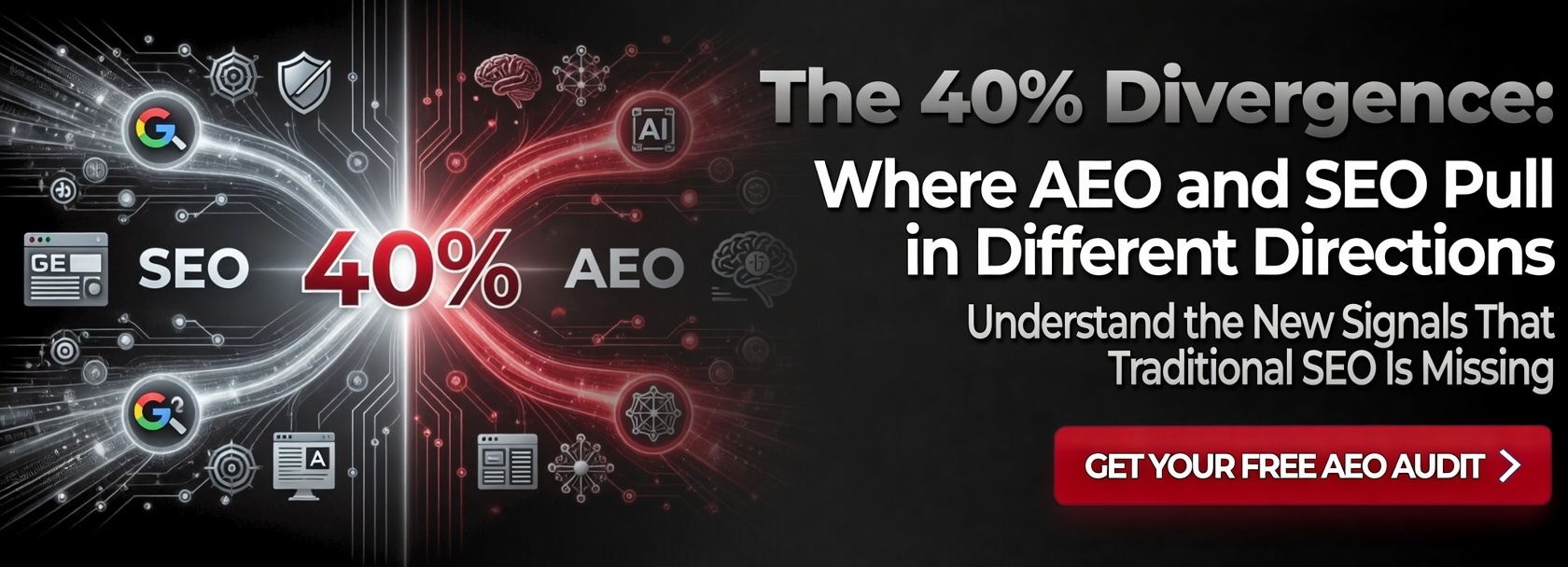
About 60 percent of AEO and SEO work overlaps. The other 40 percent pulls in different directions. This post covers where the disciplines diverge and how to navigate the conflicts The 40% Divergence: Where AEO and SEO Pull in Different Directions.
Quick answer: AEO and SEO diverge on 10 fronts: content structure, header style, trust signal weighting, keyword targeting, re-indexing speed, domain age, internal linking, schema importance, freshness, and answer specificity. The biggest splits: SEO rewards backlinks and long pages, AEO rewards entity mentions and extractable answers. Handle conflicts by answering specifically first and hedging after, with long pages that lead with the answer.
Divergence 1: Content Structure Priorities
SEO bias: comprehensive content. Longer pages that cover the topic exhaustively tend to rank better. Sites are rewarded for being the most complete resource on a topic.
AEO bias: extractable content. AI engines reward pages with short citable answer-units. The complete topic coverage matters less than whether specific answers can be pulled cleanly.
How to handle it: both, with priority on extractability. Have the comprehensive content, but make sure the citable units (specific answers to specific questions) are surfaced clearly. Long pages with buried answers underperform on AEO. Short pages with no depth underperform on SEO. The compromise: long pages with answers up front.
Divergence 2: Header Style
SEO bias: topic-style headers ("Pricing Guide for X"). Topic headers organize content for readers and help Google understand page structure.
AEO bias: question-style headers ("How much does X cost"). Question headers match user queries directly, making the content easier to cite.
How to handle it: question-style on pages targeting specific buyer questions. Topic-style on pages organizing broader content. Most service pages and informational pages benefit from question headers. Hub pages and category overviews can use topic headers.
Divergence 3: Trust Signal Weighting
SEO bias: backlinks. Domain authority, page authority, anchor text, link velocity - the link graph drives traditional ranking.
AEO bias: entity clarity and mentions. AI engines weight schema-confirmed entity identity and third-party mentions (with or without links) heavily. Backlinks help less than mentions.
How to handle it: do both. Backlink building still helps SEO. Mention building (industry coverage, expert quotes, professional associations) helps AEO more. Sites that have done aggressive backlink outreach without mention building are over-indexed on SEO and weak on AEO.
Divergence 4: Keyword Targeting
SEO bias: keyword variants. Cover multiple keyword formulations of the same intent because Google's match types vary.
AEO bias: natural language questions. AI engines understand semantic intent, so keyword variants matter less than question-matching.
How to handle it: target buyer questions in natural language. The keyword variants will be covered semantically by content that answers the question. Keyword stuffing harms both disciplines now, but the SEO penalty is slower than the AEO penalty.
Divergence 5: Re-indexing Speed
SEO reality: Google's main crawler re-indexes on its own schedule. Some pages get crawled daily, others monthly.
AEO reality: AI engines update their indices on shorter cycles for many sources. Changes can show up in AI engine responses within days.
How to handle it: prioritize AEO changes when the change matters time-sensitive content. AEO will show the result faster. SEO results will catch up over weeks.
Divergence 6: Domain Age Weighting
SEO reality: domain age and aged backlinks compound. New sites take years to compete with established competitors in competitive verticals.
AEO reality: entity clarity and content quality matter more than domain age. New sites with strong AEO foundations can compete with established sites within months.
How to handle it: this is good news for new sites. AEO is one of the few disciplines where new sites can compete head-to-head with established competitors quickly. Lean into AEO if your site is new.
Divergence 7: Internal Linking Patterns
SEO bias: link equity flows. Internal linking is about distributing PageRank to important pages.
AEO bias: topical clustering. Internal linking signals topical depth and helps AI engines understand which pages are authoritative on which topics.
How to handle it: both apply, but the linking patterns differ slightly. SEO link equity flows often concentrate links to a few important pages. AEO topical clustering distributes links within topic clusters more evenly. The compromise: pillar-and-spoke architecture where pillars get heavy linking from supporting content, and supporting content cross-links within clusters.
Divergence 8: Schema Markup Importance
SEO reality: schema helps with rich snippets and some entity recognition. Some categories benefit; others see modest impact.
AEO reality: schema is functionally required for serious performance. AI engines use schema heavily for entity verification and content extraction.
How to handle it: invest more in schema than SEO playbooks suggest. The AEO upside is large; the SEO downside is zero. Comprehensive schema deployment is one of the highest-leverage shared improvements.
Divergence 9: Content Freshness
SEO reality: freshness matters for news and trending topics. For evergreen content, last-updated dates have moderate impact.
AEO reality: freshness matters for time-sensitive topics where AI engines prefer recent sources. For evergreen content, freshness signals less but still matters more than for SEO.
How to handle it: maintain real updates on time-sensitive content. Avoid template-only updates that bump last-modified dates without changing content - both disciplines penalize this pattern.
Divergence 10: Answer Specificity
SEO reality: hedging language ("results may vary", "consult a professional") is sometimes legally required and SEO-neutral.
AEO reality: hedging language hurts citation candidacy. AI engines downgrade sources that always equivocate.
How to handle it: be specific where possible. Include hedging where legally necessary but AFTER the specific answer, not INSTEAD of one.
When Divergences Become Conflicts
Most divergences are compatible. You can satisfy both disciplines with thoughtful content choices. A few cases create genuine conflict:
Legal hedging vs answer specificity. Some industries (law, medicine, finance) face compliance requirements that mandate hedging. Compromise: answer specifically first, hedge after.
Comprehensive content vs lean extractability. Both can coexist; long pages with answer-first openings serve both.
Backlink chasing vs mention building. Time budgeting tradeoff. Shifting effort from one to the other affects both outcomes. The right balance depends on your starting position.
What to Prioritize When You Have to Choose
If you have to pick one focus, the answer depends on your starting position:
Weak SEO and weak AEO: shared foundations first. Architecture, speed, schema, content depth.
Strong SEO and weak AEO: the divergent AEO work. Restructure content, build entity signals, expand schema, fix entity hygiene. This is the most common scenario.
Weak SEO and strong AEO: the divergent SEO work. Backlink building, technical SEO optimization, content depth on established pages. Less common but real.
Strong both: maintenance for both. Steady content production, freshness, authority compounding.
Frequently Asked Questions
Can a new site compete faster on AEO than SEO?
Yes. SEO authority compounds over years through domain age and aged backlinks, so new sites take years to compete in tough verticals. AEO weights entity clarity and content quality over domain age, so a new site with strong AEO foundations can compete with established sites within months. Lean into AEO if your site is new.
Can a new site compete faster on AEO than SEO?Full Contact AEO2026-07-14T20:17:34+00:00Do backlinks matter more for SEO or AEO?
SEO weights backlinks heavily through domain authority, anchor text, and link velocity. AEO weights schema-confirmed entity identity and third-party mentions, with or without links, so backlinks help less than mentions. Sites that chased backlinks without building industry mentions end up over-indexed on SEO and weak on AEO.
Do backlinks matter more for SEO or AEO?Full Contact AEO2026-07-14T20:17:32+00:00How do I handle legal hedging versus answer specificity?
Hedging language like "results may vary" is SEO-neutral and sometimes legally required in law, medicine, and finance, but it hurts AEO citation candidacy because engines downgrade sources that always equivocate. The compromise is to answer specifically first, then place any required hedging after the specific answer rather than instead of it.
How do I handle legal hedging versus answer specificity?Full Contact AEO2026-07-14T20:17:37+00:00Is schema markup more important for AEO or SEO?
Schema matters more for AEO. For SEO it helps with rich snippets and some entity recognition, with modest impact in many categories. For AEO it is functionally required because engines use schema heavily for entity verification and content extraction. Invest more in schema than SEO playbooks suggest, since the AEO upside is large and the SEO downside is zero.
Is schema markup more important for AEO or SEO?Full Contact AEO2026-07-14T20:17:38+00:00Where do AEO and SEO pull in different directions?
They diverge on 10 fronts: content structure, header style, trust signal weighting, keyword targeting, re-indexing speed, domain age, internal linking, schema importance, freshness, and answer specificity. The biggest splits are that SEO rewards backlinks and long comprehensive pages while AEO rewards entity mentions and short extractable answers.
Where do AEO and SEO pull in different directions?Full Contact AEO2026-07-14T20:17:30+00:00Next Steps
Run the free AEO audit to see where your divergent AEO work is needed.
Read AEO vs SEO for the broader framework.
Read The 60% Overlap for what the disciplines share.
The 40% Divergence: Where AEO and SEO Pull in Different DirectionsFull Contact AEO2026-08-07T20:01:30+00:00