
The Three Layers of AEO: Content, Structure, Trust
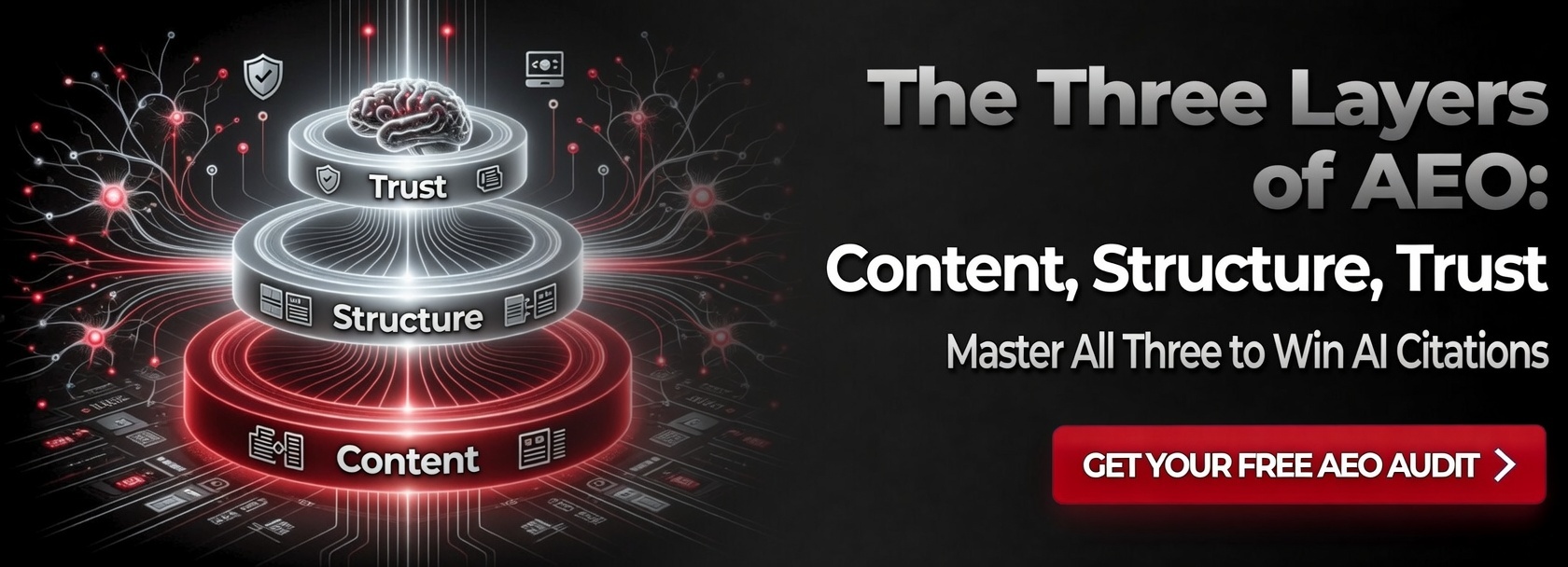
The three layers of AEO are content (what you publish), structure (how it's organized), and trust (who you are). Each layer multiplies the value of the others. This post breaks down what each layer does, how they compound, and where most sites fall short.
Quick answer: The three layers are content (buyer questions answered completely with real expertise), structure (answer-first pages, question headers, structured data, FAQ sections), and trust (entity consistency, real authorship, third-party mentions). Structure moves citation behavior within weeks and is the highest-leverage layer for most sites. Trust compounds over months to years. All three together drive citation share.
Layer 1: Content (What You Publish)
The content layer is what you put on your site. The questions you answer, the topics you cover, the depth you go to on each one.
For AEO specifically, content needs three properties:
Match real buyer questions. Not just keywords. The actual phrasing buyers use when asking AI engines. "How much does a DUI lawyer cost in Rhode Island" beats "RI DUI legal fees" because that is how buyers phrase the question, and AI engines reward question-matching.
Cover the question completely. Partial answers get partial citation. Complete answers get full citation. A page that answers most of what a buyer wants to know loses to a page that answers all of it.
Demonstrate real expertise. Specific claims, real data, original perspective. Generic summaries of widely-known information rarely get cited because every site has them. Differentiated expertise gets cited because the AI engine can pull unique perspective from your site.
Sites that nail the content layer publish consistently, each piece targeting specific buyer questions with depth and specificity. They are not content farms publishing volume; they are practitioners publishing quality.
Layer 2: Structure (How Content Is Organized)
The structure layer is HOW your content is organized. Same content, different structure, different citation behavior.
Structural fundamentals for AEO:
Lead with the answer. The opening of each page contains the specific answer to the page's target question. The narrative depth comes after.
Question-style headers. Headers phrased as questions match buyer queries directly. AI engines scan headers for question-matches and pull from the content beneath them.
Short, citable statements in key positions. Punchy statements that make specific claims are extraction-friendly. You can have long sentences elsewhere; the citation-ready statements need to be tight.
Structured data on important pages. Structured data confirms entity and content type to AI engines. Pages without it get evaluated on text alone; pages with it get evaluated with confirmed context.
Internal linking that signals topical depth. Pillar pages with clearly linked supporting content tell AI engines which pages are authoritative on which topics.
FAQ sections with natural buyer queries. Not keyword-stuffed FAQs. Actual questions buyers ask, with direct answers. AI engines weight FAQ-style content heavily as citation source material.
The structure layer is the highest-leverage AEO work because it has the fastest impact. Restructuring a page often moves citation behavior within days. AEO Ranking Factors covers structural signals in detail.
Layer 3: Trust (Who You Are)
The trust layer is WHO you are and how that signal reaches AI engines. The slowest layer to build and the hardest to fake.
Trust signals AI engines weight:
Entity consistency. Your business name, address, phone, and contact information match exactly across your site, third-party directories, social profiles, and industry publications. Mismatches create ambiguity that AI engines penalize.
Real authorship. Content with real bylines, real bios, real credentials. Anonymous "team" bylines work for some content but lose to bylined content where individual expertise matters.
Third-party mentions. Your business referenced in industry publications, news coverage, professional directories. Mentions matter more than links alone in AI citation decisions.
Authoritative outbound citations. Linking out to authoritative sources (Wikipedia, government sites, industry standards bodies, established research) signals research depth on your own pages.
Customer reviews and case studies. Real names, real outcomes, real specifics. Generic testimonials register less than specific case studies with verifiable details.
Time in market. Older sites with consistent presence build trust over time. New sites can compensate with rapid authority building but cannot rush trust accumulation entirely.
The trust layer compounds over months and years. Sites strong in trust win citations even when their content and structure are mediocre. Sites weak in trust struggle to get cited even with perfect content and structure.
How the Three Layers of AEO Compound
Each layer multiplies the value of the others.
Content without structure: gets considered but rarely cited because the answers are not extractable.
Structure without content: gets formatted nicely but nothing meaningful inside to cite.
Trust without content or structure: gets recognized as a real business but does not get cited because the relevant pages do not exist or are not citable.
Content + structure but no trust: gets cited inconsistently because AI engines cannot confirm credibility.
Trust + content but no structure: gets cited occasionally when AI engines find the buried answer; loses citations to better-structured competitors.
All three layers together: citation share that compounds over time.
Where Most Sites Are Strong and Weak
Pattern across hundreds of AEO assessments:
Most sites are okay at content. They have pages and posts. Content depth varies but most sites have basic coverage of their core topics.
Most sites are weak at structure. Pages bury answers, headers are topic-style, structured data is partial or missing, FAQ sections are missing or thin. This is the highest-ROI layer to invest in for most sites.
Most sites are mixed at trust. Established businesses have some trust signals (Google Business Profile, basic third-party listings) but rarely have systematic entity hygiene or authoritative third-party coverage. Trust takes sustained effort that most sites have not invested in.
How to Prioritize Across the Three Layers of AEO
If you have done none of the work:
Start with foundational structure (structured data, lead-with-answer, question headers). These are fast and unblock citation candidacy.
Then build content depth on the topics that matter most for your business. Pick the few most important topics and build them out completely before expanding to others.
Trust work runs in parallel. Entity hygiene cleanup is a one-time pass. Third-party mention building is ongoing.
If you have done some structural work already:
Audit what is missing structurally and finish it. Expand content into adjacent topics that share your existing pillar themes. Increase trust signal investment through author profiles, industry mentions, and original research.
If your structure is clean and your content is solid:
Focus on trust. The compounding layer that separates good AEO from great AEO. Maintain everything else.
For businesses without internal AEO capability, an AEO-focused agency can build all three layers systematically.
How Long Each Layer Takes
Structure: weeks to months. Most structural improvements show up in AI engine behavior within several weeks of the change.
Content: ongoing. New pillar pages typically need a few months to start ranking and getting cited. Supporting content compounds with the pillar over time.
Trust: months to years. Entity hygiene fixes show benefit quickly. Authority building compounds slowly. Real reputation takes years to build but compounds for decades.
Frequently Asked Questions
How long does each AEO layer take to work?
Structure takes weeks to months, with most improvements showing in engine behavior within several weeks. Content is ongoing, with new pillar pages needing a few months to start getting cited. Trust takes months to years: entity hygiene fixes show benefit quickly but authority building compounds slowly over time.
How long does each AEO layer take to work?Full Contact AEO2026-07-14T20:20:26+00:00What are the three layers of AEO?
The three layers are content, structure, and trust. Content is what you publish, the buyer questions you answer completely with real expertise. Structure is how it is organized, with answer-first pages and question headers. Trust is who you are, shown through entity consistency and third-party mentions. Each layer multiplies the value of the others.
What are the three layers of AEO?Full Contact AEO2026-07-14T20:20:19+00:00What does the trust layer include?
Entity consistency across your site and third-party directories, real authorship with bylines and credentials, third-party mentions in industry publications, authoritative outbound citations, customer reviews and case studies with real specifics, and time in market. Trust is the slowest layer to build and the hardest to fake, and it compounds over months and years.
What does the trust layer include?Full Contact AEO2026-07-14T20:20:24+00:00Which AEO layer has the fastest impact?
Structure. It is the highest-leverage AEO work because restructuring a page often moves citation behavior within days, and most structural improvements show up in engine behavior within several weeks. Leading with the answer, using question headers, adding structured data, and building FAQ sections are the fastest way to unblock citation candidacy.
Which AEO layer has the fastest impact?Full Contact AEO2026-07-14T20:20:21+00:00Which layer are most sites weakest on?
Structure. Across hundreds of assessments, most sites are okay at content and mixed at trust, but weak at structure: pages bury answers, headers are topic-style, structured data is partial or missing, and FAQ sections are thin or absent. That makes structure the highest-ROI layer to invest in for most sites.
Which layer are most sites weakest on?Full Contact AEO2026-07-14T20:20:28+00:00The Three Layers of AEO - Next Steps
If you want to know which of the three layers of AEO is your weakest, run our free AEO audit. The report tells you where you stand in each.
For the broader strategic framework, What is Answer Engine Optimization is the pillar resource.
For the specific signals each layer optimizes, AEO Ranking Factors is the deep-dive.
The Three Layers of AEO: Content, Structure, TrustFull Contact AEO2026-08-07T20:01:34+00:00