
AEO Timeline: When to Expect Results From AEO Investment
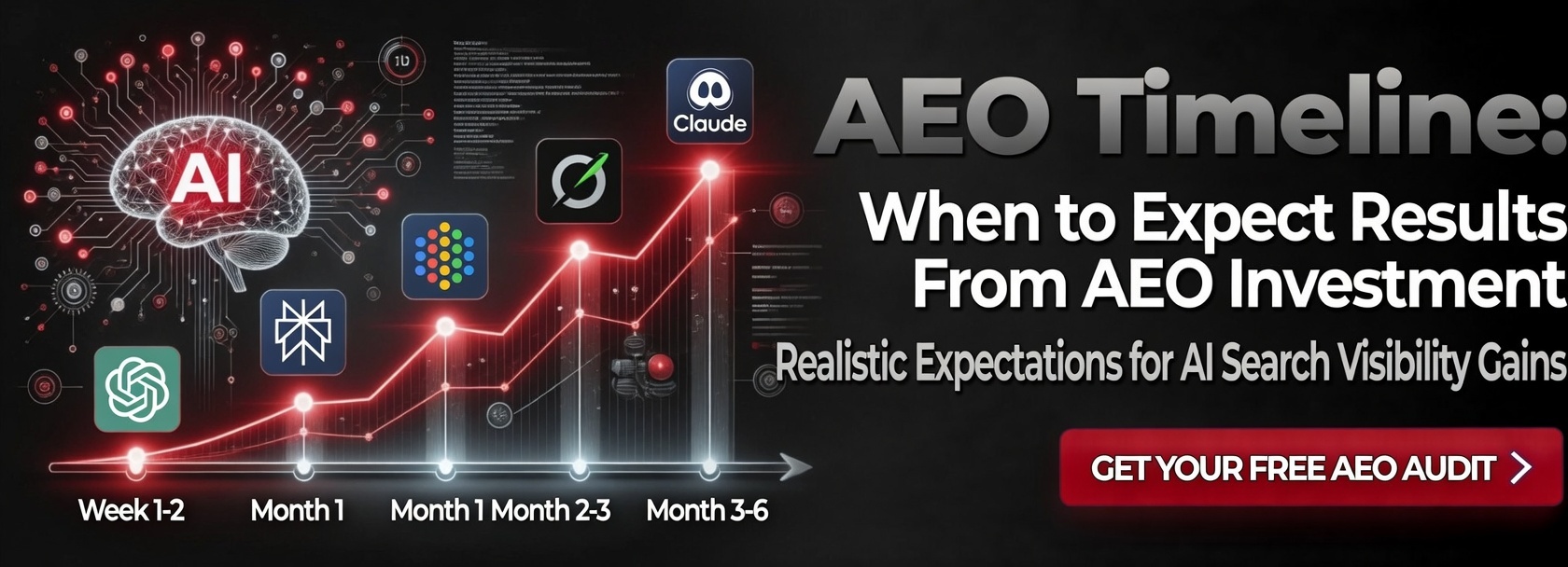
"How long will this take to work" is the question every AEO program faces. The honest AEO timeline depends on what stage you're starting from and what you mean by "work." This post breaks down realistic expectations so you can set the right targets.
Quick answer: The AEO timeline runs in three stages. Audit score improvements show up in days to weeks. AI citations in ChatGPT, Perplexity, Microsoft Copilot, and Google AI Overview start appearing in 60 to 120 days. Revenue from AI search follows in six to twelve months. Consistent execution is what compresses the timeline.
What an AEO Timeline Actually Measures
Three distinct outcomes that AEO produces, on different timelines:
Audit score improvement. The internal metric. Moves fastest because it reflects your site's structural state. Can change within days of work.
AI engine citation appearances. The intermediate metric. Your site appearing in ChatGPT, Perplexity, AI Overview, and similar responses. Moves within weeks to months.
Revenue from AI search. The terminal metric. Citation share translating to qualified traffic, leads, and customers. Moves over months to quarters depending on category and existing conversion funnels.
People who promise "AEO in 30 days" usually mean the first one. Real impact on revenue takes longer.
Early Phase: Foundational Fixes
The fastest results come from foundational fixes: crawler access, structured data deployment on key pages, fixing crawl errors, page speed improvements, mobile usability fixes.
Audit score impact: visible within a week. Often noticeable jumps from a single round of foundational fixes.
Citation impact: minimal in this window. Citation behavior changes when AI engines re-crawl and re-evaluate, which usually takes several weeks after the changes.
Revenue impact: none yet. Too early.
Structural Phase: Content and Schema Work
Content restructuring (lead with answers, question-style headers, FAQ-style content), structured data expansion across more pages, internal linking improvements, entity hygiene cleanup.
Audit score impact: continues to climb. Most sites that started weak see meaningful score gains in this window with consistent work.
Citation impact: starts appearing. AI engines that re-crawled after foundational fixes are now finding the structural improvements. Citations for less competitive queries start showing up.
Revenue impact: still early. Some AI engine referrer traffic may appear but volume is small relative to mature traffic sources.
Content Investment Phase
New pillar pages, supporting blog content, deeper coverage of buyer questions, expanded topical clusters.
Audit score impact: continues incrementally. Diminishing returns set in compared to the foundational and structural phases.
Citation impact: meaningful and growing. New content gets indexed and cited within weeks of publication. Sites become reliable citation sources for several buyer-intent queries in their category.
Revenue impact: starting to be measurable. AI engine referrer traffic becomes a real channel. Leads from AI-cited content begin showing up in CRM with attribution where it can be tracked.
Authority Phase
Third-party mention building, industry coverage, expert positioning, author profile development, original research publication.
Audit score impact: slower incremental gains. Most sites plateau here unless they invest in authority. The audit can only measure so much of authority directly.
Citation impact: significant. Citations across multiple AI engines for category-defining queries. Brand recognition in AI responses.
Revenue impact: visible. AI search becomes a meaningful traffic source. Conversion rates from AI-sourced traffic typically match or exceed organic search traffic because the intent is high.
Mature Phase: Compounding
Continued content production, sustained authority work, maintenance of foundational and structural signals.
Audit score: high plateau. Marginal returns on score improvement past this point.
Citation share: significant. Established as the cited source for multiple queries in your category. Defending citation share from competitors becomes the work.
Revenue: AI search is a top traffic channel for most sites in this phase. Pipeline contribution measurable in monthly reporting.
What Speeds Up or Slows Down Your AEO Timeline
What slows things down:
Starting from low foundation. Sites with weak foundations spend the first phase just clearing the basics before structural work meaningfully begins.
Inconsistent execution. Stopping and starting kills the compounding. Sites that do AEO sporadically take far longer to reach the same outcomes as sites that execute steadily.
Authority deficit. Sites with no existing third-party presence take longer because authority cannot be sprinted. Building it from zero is the slowest layer.
Competitive category. Categories where competitors have done AEO well take longer because you are not just appearing; you are displacing existing cited sources.
Hostile platform. Sites built on platforms that fight modern best practices (no structured data support, slow page templates, broken mobile) need rebuilds before AEO can work.
What speeds things up:
Good starting foundation. Sites with strong existing audit scores can move quickly with focused work.
Existing brand authority. Known businesses with established third-party presence inherit authority signals AI engines weight heavily.
Concentrated effort. Sustained focused sprints outperform spread-thin year-long programs.
Specific topical focus. Sites that pick a narrow set of topics to dominate move faster than sites trying to cover everything.
Existing content library. Sites with deep content backlog can restructure existing pages (faster) rather than producing new content (slower).
Setting Realistic AEO Timeline Expectations
For a typical site starting at an average audit score:
Within the first month, foundational fixes should be complete and audit score should reflect that work.
Within the first quarter, structural work should be in place on the top pages and the first AI engine citations should be appearing.
Within the first six months, content investment should be producing newly-cited pages, and AI engine referrer traffic should be measurable.
Within the first year, citation share should be established in the category and AI search should be a meaningful traffic source.
Sites that hit these markers are on track. Sites that fall behind need to look at execution quality or scope.
AEO Timeline - When to Reset Expectations
If a few months in shows no audit score movement and no early citations, something is wrong. Possibilities: the work is not addressing the right items, technical issues are blocking deployment, the audit is measuring different things than AI engines actually weight.
The diagnostic: audit yourself, audit competitors, ask AI engines real buyer questions and see who is being cited. If competitors who started at the same level are visibly ahead, your execution needs review.
For programs that want a faster audit-execution-measure cycle, an AEO Agency compresses the timeline by running the work and the reporting in parallel.
AEO Timeline - What to Tell Clients (If You Are an Agency)
Honest framing: AEO improvements show up in audit scores within weeks, in AI citations within several months, and in measurable revenue within roughly six to twelve months. The first measurable indicator to report on monthly is citation appearances; expect those to start a couple of months in for most categories.
Avoid "AEO results in 30 days." That promise sets up disappointment and damages trust when the second month arrives without revenue impact.
Frequently Asked Questions
Can I get AEO results in 30 days?
You can move your audit score in 30 days, and foundational fixes should be complete in the first month. Citations and revenue take longer. Anyone promising full AEO results in 30 days is selling the fastest metric and hiding the other two.
Can I get AEO results in 30 days?Full Contact AEO2026-07-14T19:40:39+00:00How long does AEO take to work?
Audit score improvements show within days to weeks. AI citations in ChatGPT, Perplexity, Microsoft Copilot, and Google AI Overview start appearing in 60 to 120 days. Revenue from AI search typically follows in six to twelve months. The stage you start from and how consistently you execute decide where you land in those ranges.
How long does AEO take to work?Full Contact AEO2026-07-14T19:40:37+00:00What makes AEO results come faster?
A strong starting foundation, existing brand authority, concentrated effort, a narrow topical focus, and an existing content library you can restructure instead of writing from scratch. Sites with those advantages see citations near the front of the 60 to 120 day window.
What makes AEO results come faster?Full Contact AEO2026-07-14T19:40:40+00:00What slows AEO results down?
A weak starting foundation, inconsistent execution, no third-party authority, a competitive category where you must displace already-cited sources, and platforms that block structured data or fast pages. Authority is the slowest layer because it cannot be sprinted.
What slows AEO results down?Full Contact AEO2026-07-14T19:40:42+00:00When should I worry that AEO is not working?
If a few months in you see no audit score movement and no early citations, review execution. Audit your own site, audit competitors, then ask the engines real buyer questions and see who gets cited. If competitors who started at your level are visibly ahead, the work needs a scope or quality check.
When should I worry that AEO is not working?Full Contact AEO2026-07-14T19:40:44+00:00Next Steps
Run the free AEO audit to set your baseline.
Read What is Answer Engine Optimization for the strategic framework.
Read The Three Layers of AEO for which work happens in which phase.
AEO Timeline: When to Expect Results From AEO InvestmentFull Contact AEO2026-08-07T05:12:21+00:00